My wife and I tried for years to have a baby. When we finally got pregnant, we lost the child late in the pregnancy. My wife stopped smiling. She stopped living. One evening I sat in an empty church and prayed. What I heard on my way home felt like an answer.
I hadn’t planned to pray that night.
I don’t even know if I believe in signs, divine intervention, or whatever you want to call it. But after losing the child we’d waited years for, I found myself alone on a bench in a small church, whispering one request.
“Please. Give my wife her joy back.”
I didn’t ask for a baby. Or a miracle. Just Hannah’s smile.
I left the church with the weight of desperation on my shoulders.
It was late. I walked toward my car through a dark alley, my hands shoved deep into my pockets.
That’s when I heard it — a baby crying.
At first, I thought it was my imagination.
After losing a child, your mind does strange things. You hear cries. You see strollers where there are none. You’re haunted by the life that could have been.
But this cry was real.
Faint. Desperate. Growing louder as I approached the dumpster at the end of the alley.
She was there.
A teenage girl, maybe sixteen or seventeen. Hoodie pulled low over her head, face streaked with tears. In her arms was a newborn with a red, wailing face.
I stopped a few steps away. “Miss? Are you okay? Do you need help?”
“Go away,” she snapped.
“It’s cold. And the baby—”
“Leave or I’ll call the police.”
I should have walked away. I know that. A grown man approaching a teenage girl in a dark alley — that can go wrong fast.
But when I heard that baby cry, I couldn’t.
“Okay,” I said carefully. “Then I’ll call the police.”
She grabbed my sleeve, her hand shaking. “No. Please. Don’t. They’ll take him away.”
Her name was Kara.
She told me her father had thrown her out when he found out she was pregnant. The boyfriend who promised to stay disappeared the moment things got serious.
She’d been sleeping wherever she could, surviving on scraps, trying to keep her baby — Milo — alive through sheer determination.
“I’m not a bad mom,” she whispered. “I’m trying. I just don’t know how.”
I looked at that girl in the freezing alley, clutching her baby, and I knew I was looking at raw despair.
“Come with me,” I said. “Just for tonight. A warm bed. Food. Tomorrow we’ll figure something out.”
She nodded.
Walking home with them, anxiety twisted in my chest.
I wasn’t just bringing strangers into our house. I was bringing a baby. Into a home where my wife still slept.
Hannah and I had been together long enough that people stopped asking if we wanted kids. The truth was crueler: we wanted one more than anything. It just never happened.
For years our lives became a calendar of hope and heartbreak.
When it finally worked, everything changed.
Hannah bought a dozen tiny outfits and tucked them into a drawer.
And then we lost our baby.
The look on her face when she understood what was happening still haunts me.
She stopped laughing. She moved through the house like she no longer belonged in it.
I tried everything. Therapy. Date nights.
Nothing worked.
That’s why I was in that church.
When we reached the house, Kara hesitated on the porch like she might run. Milo began to fuss again.
I opened the door — and Hannah was standing there.
She looked at Kara. Then at the baby.
Something crossed her face. Pain. Recognition.
I rushed to explain. “I found her behind the dumpster near the laundromat. She has nowhere to go. It’s freezing.”
Hannah didn’t yell. Didn’t cry. Didn’t even speak at first.
She just stared at Milo.
“I can leave,” Kara whispered.
And then my wife stepped aside and said quietly, “Come in.”
That night was tense and silent.
I made tea. No one drank it. Milo cried. Hannah stood in the hallway.
Then, without a word, she grabbed her coat and keys.
“Where are you going?” I asked.
She didn’t look at me. “Formula. Diapers. Something warm for him.”
She came back an hour later with bags in both hands.
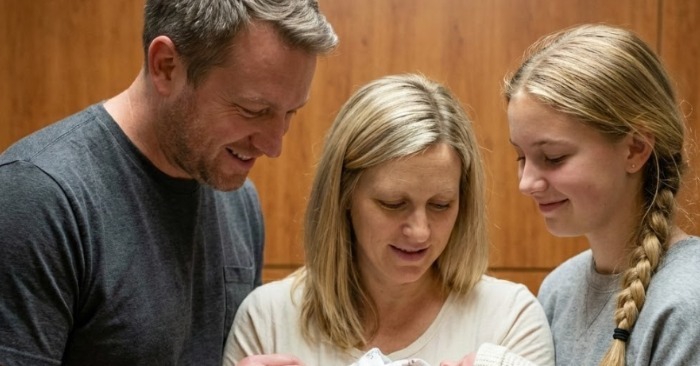
In the middle of the night, I woke up and saw Hannah sitting on the couch. Kara was asleep beside her. Milo was pressed against my wife’s chest.
I stood in the dark and cried.
The next morning, I woke to laughter. A baby’s laugh.
For the first time in months, Hannah smiled.
She insisted Kara and Milo stay longer — until we could find a solution.
I wish I could say everything became perfect after that. It didn’t.
There were nights Hannah still cried. Mornings when she looked at Milo with a complicated ache — like she was holding two babies at once: the one in her arms and the one we lost.
Kara was kind, but wounded. She apologized for everything. She flinched when I shut a cabinet too loudly.
Then came the storm.
A few weeks later, someone knocked on the door.
A man stood there, jaw tight.
“So this is where you’re hiding,” he said loudly enough for Kara to hear.
She froze.
I stepped forward. “Who are you?”
“I’m Kara’s father. She’s a minor. She’s coming home.”
Then he said something that sent cold down my spine.
“That girl is hiding something from you.”
He showed me a photo on his phone. Kara standing between two adults in a large, luxurious house. She didn’t look like someone you’d find behind a dumpster.
“She’s coming home. But the baby isn’t.”
He said Kara had “ruined his life” with an older boyfriend. Called her selfish. As if being a scared teenager in love was a crime. He’d seen us buying baby supplies and followed us home.
I heard Kara crying behind me.
Then Hannah stepped beside me.
“You threw your own child out,” she said calmly. “You didn’t come to protect her. You came to punish her.”
He tried to push past us.
“If you step inside, I’ll call the police,” Hannah said.
“Go ahead.”
“I’ll tell them you kicked out your underage daughter, refused shelter to her and your grandson, and showed up here to intimidate her. And they’ll hear that she’s afraid of you.”
He stopped.
He didn’t apologize.
He just left.
Inside, Kara was shaking so badly she couldn’t hold Milo.
Hannah sat beside her and wrapped her arms around both of them.
That evening, my wife said something I will never forget:
“We lost our baby. But this house can still be a home.”
So we did what needed to be done.
We documented everything. The eviction. The threats. We found a family lawyer. Contacted the proper agencies. Helped Kara access support and medical care.
Because she was a minor, and her father clearly demonstrated he couldn’t provide a safe, stable environment — especially with a newborn — we were granted legal guardianship.
Kara needed safety. Milo needed stability. Her father provided neither.
And now?
Kara is finishing school. She works part-time at a restaurant. Milo is growing strong and healthy. And Hannah laughs again.
We didn’t get the baby we prayed for.
But we got a family.
I asked for a sign. I didn’t expect it to come in the arms of a frightened teenage girl who just needed someone to say, “You can stay. You matter. You’re safe here.”
Some families are born.
Others are built.