
Machines breathed for him, rhythmically drawing in and releasing air. The monitors displayed calm, repetitive lines. Renowned specialists flew in from the farthest corners of the world, analyzed test results, conducted further examinations — and left with the same helpless expression on their faces.
The name on the door still commanded respect: Leonard Whitmore. Billionaire. Industrial magnate. A man who once belonged to the most influential figures in the country.
But now it no longer meant anything.
A coma does not care about power or money.
THE DIAGNOSIS HAD BEEN ESTABLISHED LONG AGO: A PERMANENT VEGETATIVE STATE.
The diagnosis had been established long ago: a permanent vegetative state. No response to voice. No reaction to touch or pain. No sign that the mind hidden behind closed eyelids was still present. His vast fortune funded an entire hospital wing, yet his body remained completely motionless within it.
After ten years, even hope had begun to fade.
That morning, the doctors gathered to complete the final documents. Not to end his life — but to change what would happen next. To transfer him to a long-term care facility. To withdraw intensive treatment. To accept that the waiting had already lasted long enough.
And on that very same day, Malik accidentally walked into room 701. Malik was eleven years old. He was small for his age. He often walked barefoot. His mother cleaned the hospital corridors at night, and after school Malik waited for her there, because he had nowhere else to go. He knew which vending machines swallowed coins. Which nurses returned a smile. And which hallways were the quietest.
He also knew which rooms he was absolutely not allowed to enter.
Room 701 was one of them.
Yet Malik had passed that glass wall countless times. He had seen the man lying there — motionless, surrounded by wires and tubes, immersed in silence. To Malik, it didn’t look like sleep.
It looked like being stuck.
THAT AFTERNOON, A POWERFUL STORM FLOODED A LARGE PART OF THE AREA.
That afternoon, a powerful storm flooded much of the area. Malik arrived at the hospital soaked to the bone — mud covered his hands, knees, and clothes. Security was distracted. The door to room 701 was not locked.
The boy stepped inside.
Leonard Whitmore looked exactly as he always did — pale skin, dry lips, eyelids closed as if time itself had sealed them.
Malik stood by the bed, unsure of what to do.
— My grandma lay like this too, — he whispered, though there was no answer in the room. — They said she was gone. But I talked to her. I know she could hear me.
HE CLIMBED ONTO A CHAIR BESIDE THE BED.
He climbed onto a chair beside the bed.
— Everyone talks about you like you’re not here, — Malik said quietly. — That must be very lonely.
And then he did something that, in ten years, no doctor, no specialist, and no family member had done.
He reached into his pocket.
He pulled out a handful of wet soil — heavy, dark, smelling of fresh rain.
SLOWLY, VERY GENTLY, HE SMEARED THE MUD ON THE BILLIONAIRE’S FACE.
Slowly, very gently, he spread the mud across the billionaire’s face.
On the cheeks. On the forehead. Along the nose.
— Please don’t be angry, — he whispered. — My grandma used to say the earth remembers us. Even when people forget.
A nurse entered the room — and froze.
— HEY! WHAT ARE YOU DOING?!
MALIK JUMPED IN FEAR.
Malik jumped in fear. Security immediately arrived. Raised voices echoed through the room. The boy cried, apologizing over and over as he was led out, his mud-covered hands trembling.
The doctors were furious.
Sterility rules had been broken. The patient’s safety had been compromised. Legal consequences were possible.
They immediately began cleaning Leonard Whitmore’s face.
And then the monitor reacted.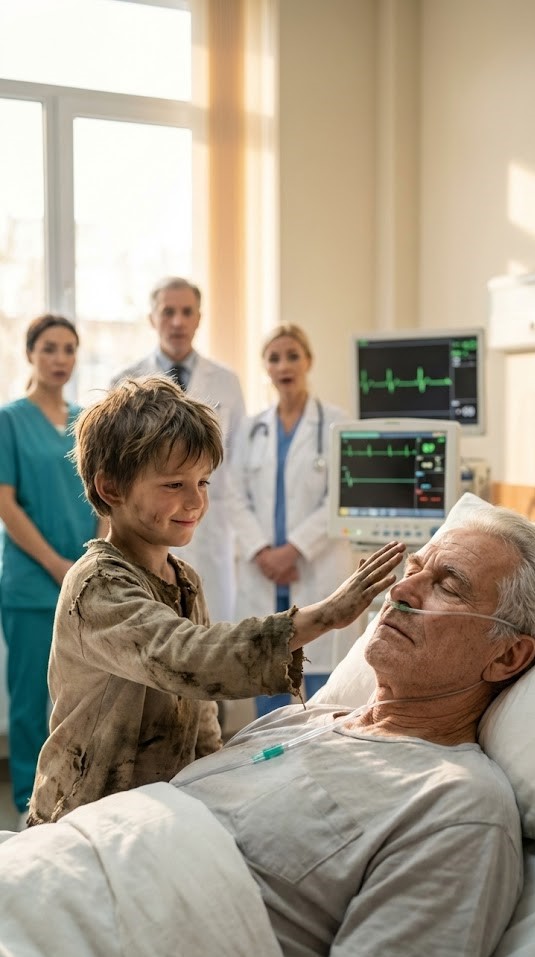 — Wait a second, — one of the doctors said sharply. — Did you see that?
Another signal. And another.
Leonard’s fingers twitched.
SILENCE FILLED THE ROOM.
Silence filled the room.
Tests were ordered immediately. Brain activity appeared on the monitors — focused, clear, new. It wasn’t random. It was a response.
Within a few hours, Leonard Whitmore began to show signs that had not appeared once in ten years.
Muscle reflexes. Pupil response. Subtle but measurable reactions to sound.
Three days later, Leonard opened his eyes.
WHEN THE DOCTORS LATER ASKED HIM WHAT HE REMEMBERED, HIS VOICE TREMBLED.
When the doctors later asked him what he remembered, his voice trembled.
— I smelled rain, — he said. — Earth. My father’s hands. The farm where I grew up… before I became someone else.
The hospital tried to find Malik.
At first, without success.
But Leonard insisted on it.
WHEN THE BOY FINALLY RETURNED TO THE HOSPITAL, HE STOOD WITH HIS HEAD LOWERED.
When the boy finally returned to the hospital, he stood with his head lowered.
— I’m sorry, — he whispered. — I didn’t mean to cause trouble.
Leonard reached out and took his hand.
— You reminded me that I’m still alive, — he said. — Everyone else treated me like a body. You treated me like a person who still belongs to this world.
Leonard paid off all his mother’s debts. He funded Malik’s education. He built a community center in their neighborhood.
BUT WHEN HE WAS ASKED WHAT TRULY SAVED HIM, LEONARD NEVER ATTRIBUTED IT TO MEDICINE.
But when he was asked what truly saved him, Leonard never attributed it to medicine.
He always answered:
— A child who believed I was still there… and had the courage to touch the earth when everyone else was afraid.
And Malik?
He still believes that the earth remembers us.
EVEN WHEN THE WORLD HAS ALREADY FORGOTTEN.
Even when the world has already forgotten.