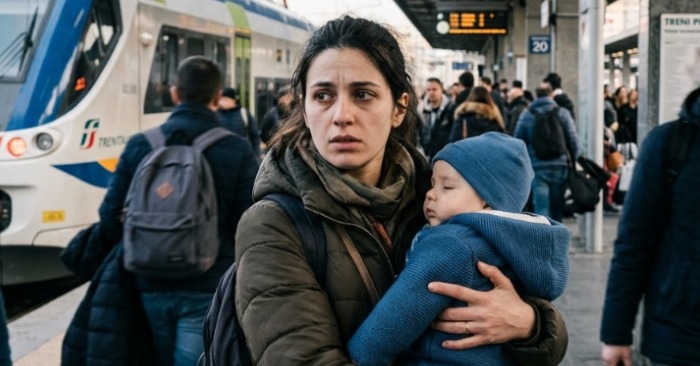
The station was loud and stifling. The air was thick with the scent of warm croissants, the metallic smell of trains, and the dust of travel. Laura sat on a hard wooden bench, watching the departure board. Her train was delayed by two hours.
She was traveling to her sister’s place in a nearby town. Just for a week — to breathe, to escape the loneliness, the empty apartment, and the thoughts that kept her awake at night. Forty years old, no husband, no children. She had devoted her entire life to working at the clinic and making occasional visits to family.
“Excuse me! Ma’am!”
Laura looked up. In front of her stood a young, disheveled woman holding a baby in her arms. The child was crying desperately, screaming without pause, and the woman was trying to calm him while nervously glancing around. There was so much panic in her eyes that Laura immediately felt tense.
“Could you hold him for a moment?” the woman said quickly. “I have to go buy tickets at the counter, but they won’t let me through with him. They say it’s crowded, that the baby is in the way. I’ll be right back, really! Just a moment, I’ll be right back!”
Laura hesitated for only a second. Someone else’s child — anything could happen. But the woman looked at her with such desperation, and the baby was crying so heartbreakingly, that Laura’s chest tightened with pain.
“Alright,” she said, taking the warm bundle into her arms.
The woman ran toward the ticket counters and disappeared into the crowd.
LAURA WAS LEFT ALONE WITH THE BABY.
He was heavier than he looked — around four months old. Almost immediately, he stopped crying, gazed at her through sleepy eyes, and began breathing calmly. Laura rocked him gently and adjusted the blanket wrapped around him. It was old and worn, but clean.
Ten minutes passed. Twenty. Half an hour.
The woman did not return.
Laura stood up and walked toward the ticket counters. There were no more lines, only a few people standing at the windows. She crossed the entire station, checked the restroom, the café, and went out to the platform. No one.
Her heart began to beat faster and faster.
She returned to the bench. Sat down. The little one stirred and let out a quiet murmur. Laura lifted the blanket — maybe there was a note hidden there? Nothing. Just a small scratch on his arm covered with a bandage.
Her train left. She didn’t even notice.
LAURA STAYED AT THE STATION FOR THREE DAYS.
She couldn’t leave. What if that woman came back? What if something had happened to her? What if she was looking for the baby and couldn’t find him?
She fed the little boy with a bottle she found in the bag — there was powdered milk, diapers, and a spare shirt inside. So the woman had been prepared. This had not been a sudden decision.
On the second night, Laura realized something strange was happening to her. Her breasts became swollen and painful. She went into the station restroom, unbuttoned her blouse, and froze: milk.
Milk in a woman who had never given birth.
Sitting on the floor of the stall, she stared at the white drops and cried. She didn’t know whether from pain, fear, or something she couldn’t even name.
On the third day, she went to the police…
Laura stood in the hallway of the station, clutching the small bundle so tightly that it seemed loosening her grip might cause everything to vanish like a bad dream. The baby was breathing peacefully against her, already used to her scent, her voice, and the rhythm of her heartbeat. And that was what made everything even harder.
“YOU WANT TO SAY THE MOTHER JUST… WALKED AWAY?” the officer raised his eyebrows, looking first at her and then at the child.
“She said, ‘I’ll be right back,’” Laura replied quietly. “And she never came back. I waited three days.”
The man sighed and wrote something down.
“It happens. Unfortunately, not all that rarely. It’s good that you came.”
Those words hit her. Good. And what would have been bad? Leaving? Abandoning him? Forgetting?
“Will you take him?” she asked suddenly, and her voice trembled.
“For now, he’ll be sent to the hospital for tests. Then, if the mother doesn’t come forward — to a care facility,” the officer explained calmly.
Laura fell silent. She looked at the little face, the tiny nose, the soft lips moving slightly in sleep. And she felt something tighten inside her so hard it almost took her breath away.
“CAN I… CAN I VISIT HIM?” SHE ASKED, ALMOST IN A WHISPER.
The officer studied her carefully.
“Are you family?”
“No.”
“In that case… officially, no. But you can try applying for temporary guardianship. If you want to.”
Laura did not answer right away. She only nodded faintly. As if it were a simple decision. As if she had already made it.
The hospital smelled of disinfectant and silence. The baby was taken away for tests, and Laura remained in the corridor, clutching the empty blanket. Her hands were shaking.
“Are you his mother?” a nurse asked, leaning out from the room.
LAURA FROZE. THE WORD HUNG IN THE AIR AS IF IT WERE WAITING FOR HER TO EITHER ACCEPT IT OR REJECT IT.
“No…” she began, but stopped. “I… I don’t know.”
The nurse looked at her for a little longer than necessary, then said softly:
“The baby is healthy. But he needs a mother. Not ‘someone.’ A mother.”
Those words struck deeper than any explanation.
That evening, Laura returned home — for the first time since those days. The apartment greeted her as it always had. The same wardrobe. The same table. The same cups. But something was different. There was too much space. Too much emptiness.
She put down her bag and suddenly understood: there was no crying.
That silence was not peace. It was emptiness.
LAURA SAT ON THE EDGE OF THE BED AND PRESSED HER HANDS TO HER CHEST. THEY WERE SWOLLEN AGAIN, WARM, PAINFUL. HER BODY DID NOT UNDERSTAND WHAT HAD HAPPENED. IT SEEMED TO KNOW ONLY ONE THING: THERE IS A BABY. THE BABY MUST BE FED.
“This is absurd…” she whispered. “I’ve never given birth…”
But the body asked no questions.
The next morning, she was back at the hospital. She stood outside the ward door, not daring to go in.
“Who are you looking for?” another nurse asked.
“The baby… the one from the station.”
“Ah, yes. Please, go in.”
Laura stepped inside slowly, as if afraid someone might throw her out. But no one did. The baby was lying in the crib, calm, staring up at the ceiling.
SHE MOVED CLOSER.
“Hi…” she said softly.
At that moment, the baby turned his head and looked straight at her.
It was not an ordinary look. He recognized her.
It was so obvious that Laura stepped back as if someone had spoken it aloud.
“Did you hold him before?” the nurse asked.
“Yes… for three days.”
“It shows. He responds to you.”
LAURA HELD OUT HER ARMS. THEY LET HER. SHE TOOK THE BABY CAREFULLY, AND HE IMMEDIATELY CALMED DOWN, SNUGGLING AGAINST HER AS IF IT WERE THE MOST NATURAL THING IN THE WORLD.
“He’s hungry,” the nurse said. “I’ll bring formula.”
Laura pressed her lips together.
“That won’t be necessary…” she said quietly.
The nurse frowned.
“I’m sorry?”
Without saying anything more, Laura unbuttoned her blouse. Her hands were trembling, but her movements were certain. She herself did not know where that certainty came from.
“I have milk.”
SILENCE FILLED THE ROOM.
“Are you sure?” the nurse asked softly.
Laura nodded.
The baby latched on immediately. Without hesitation. As if he knew.
And in that moment, something inside her finally fell into place.
Laura closed her eyes. And for the first time in a very long time, she did not feel emptiness.
She felt complete.
Several weeks passed. Documents, certificates, files, inspections. Social workers came to her home, asked questions, looked into the closets, the refrigerator, even the bathroom.
“DO YOU REALIZE THIS IS AN ENORMOUS RESPONSIBILITY?” ONE OF THE WOMEN ASKED STERNLY.
“Yes,” Laura answered.
“You’re alone. No husband.”
“Yes.”
“And even so, you want to take the child?”
Laura looked her in the eyes.
“It’s not a matter of wanting. I have no choice.”
It was not a beautiful sentence. It was a true one.
ONE DAY, THE PHONE RANG.
“We found the mother,” said a voice on the other end.
For a moment, the world stopped.
“Where is she?” Laura whispered.
“In the hospital. After an overdose. She barely survived.”
Laura sat down.
“Will she take the child?”
Silence.
“SHE SIGNED AWAY HER RIGHTS.”
Those words did not bring relief. They were heavy. Like a sentence.
“She left a letter,” the voice added. “For the person who found the child.”
Laura went immediately.
The doctor handed her a crumpled sheet of paper.
The handwriting was shaky.
“I am not a bad person. I just can’t do it anymore. I have no money, no strength. If you’re reading this, it means you didn’t walk away. You are better than I am. Please, don’t send him to an orphanage. He is a good boy. His name is Massimo. Forgive me.”
Laura sat with the letter for a long time.
“Massimo…” she repeated softly.
Then she looked at the baby.
He was asleep in her arms, peaceful, warm, familiar.
“Alright, Massimo…” she whispered with a faint smile. “I’m not going anywhere. I promise you.”
The baby stirred slightly, as if he had heard her.
And for the first time in forty years, Laura understood: her life was only just beginning.