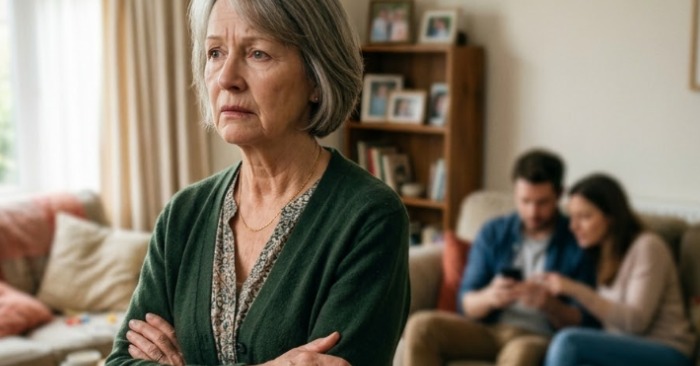
— Mom, you understand yourself… we have a mortgage, we’re still paying off the car, and we’ve just signed Matteo up for football training. This really isn’t the time for extra expenses. You have your pension, something comes in every month. You’ll manage somehow — Marek said, not even lifting his eyes from his phone, scrolling aimlessly with his finger.
Józefina stood by the stove, stirring the soup. She had invited her son for lunch because she wanted to ask him for something. Her blood pressure kept fluctuating, the doctor had prescribed a new medication, but it cost nearly two hundred euros. With a pension of nine hundred euros, that was a lot — especially when over three hundred went to rent, then electricity bills, phone bills, and she still had to eat.
She didn’t want to complain. She only asked: “Marek, could you help me this month with the medication?” And that was the answer she received.
— Marek, I’m not asking for much. It’s just two hundred euros for the pills. You know I have high blood pressure.
— Mom, buy something cheaper. There are substitutes. Ask at the pharmacy, they’ll give you something similar.
Józefina turned off the stove and set the pot aside. Her hands were calm, steady — she had worked as a seamstress in a factory for thirty years, and her hands had never trembled. Something else trembled. Inside.
Marek finished his soup, wiped his mouth with a napkin, quickly kissed his mother on the head, and left. Józefina cleared the plate, washed it, and placed it on the drying rack. Then she sat down at the kitchen table, rested her cheek on her hand, and fell into thought.
She has two children. Marek is older, thirty-eight years old, with a wife, Sylwia, and a seven-year-old son, Matteo. Her younger daughter, Laura, is thirty-four, with a husband, Aleksander, and twins — Klara and Łukasz, four years old. They all live in the same city, they work, they earn well. Houses, cars, new phones every year. Laura’s husband recently bought her a mink coat, and she posted a photo in the family group with the caption: “Girls, today I’m a queen!”
And while the “queen” was smiling in the photo, her mother was calculating whether her money would last until the end of the month if she bought her medication.
JÓZEFINA RAISED HER CHILDREN ALONE. HER HUSBAND LEFT WHEN LAURA WAS TWO YEARS OLD. HE PACKED A SUITCASE AND SAID ONLY: “JÓZEFINA, I’M SORRY, BUT I CAN’T DO THIS ANYMORE.” HE NEVER EXPLAINED WHAT EXACTLY HE COULDN’T HANDLE. AT FIRST HE SENT SOME MONEY, THEN HE STOPPED. JÓZEFINA FILED FOR CHILD SUPPORT, BUT THE MAN MOVED TO ANOTHER CITY AND WORKED OFF THE BOOKS. NOTHING COULD BE ENFORCED.
She managed on her own. During the day she sewed in the factory, in the evenings she took extra work home — shortening trousers, fixing coats, sewing on patches. She slept five hours a night. The children were clothed, had shoes, had food. Marek went to football, Laura to art classes. Józefina saved on herself — on clothes, on food, on everything. But the children had everything she could give them.
When they grew up and became independent, Józefina retired. The factory was barely surviving, people were being laid off, so she left before they dismissed her. Thirty years of work — and a modest pension, like many others. At first, though, it was manageable: Marek and Laura helped. They brought groceries, bought medication, sometimes left some money “for the house.”
Then the help began to fade. At first almost unnoticed — instead of every month, once every two months. Then even less often. Eventually it stopped altogether. Józefina said nothing, because she felt ashamed. It seemed humiliating to ask her own children. She thought they should understand on their own.
But they didn’t. Or they pretended not to.
The grandchildren, however, appeared regularly. Every weekend. Sometimes during the week as well.
Laura usually called on Friday evening.
— Mom, tomorrow Aleksander and I are going to the mall, we want to look at new bedroom furniture. Can you take the twins for the whole day? You know they adore you!
JÓZEFINA AGREED. BECAUSE SHE TRULY LOVED HER GRANDCHILDREN. KLARA AND ŁUKASZ WERE FUNNY, LOUD, IDENTICAL LIKE TWO DROPS OF WATER, AND YET COMPLETELY DIFFERENT. KLARA WAS CALM, SHE LIKED DRAWING AND SITTING IN A CORNER WITH CRAYONS. ŁUKASZ WAS LIKE A HURRICANE — RUNNING, JUMPING, KNOCKING EVERYTHING OVER. AFTER HIS VISITS, JÓZEFINA SPENT HALF A DAY CLEANING AND FIXING THE WALLPAPER HE SOMETIMES TORE OFF THE WALL.
Matteo, Marek’s son, came less often but stayed longer. Marek brought him when he and Sylwia went out somewhere. To the cinema, a restaurant, to friends. “Mom, just for two hours.” Those two hours turned into six or seven. Matteo stayed overnight, and Marek picked him up only in the morning.
Józefina cooked porridge for the grandchildren, made pancakes, took them to the park, put them to bed, read bedtime stories. She liked doing it. She liked feeling needed. But her body was no longer what it had been ten years earlier. Her knees hurt, her back ached after every bend, her blood pressure rose. And the medication cost money, and money was lacking.
One day Laura brought the twins, and while helping them take off their jackets in the hallway, she said casually:
— Mom, can you take them on Wednesday too? Aleksander has a business dinner, and I’m going to the hairdresser.
— Laura, I have a doctor’s appointment on Wednesday.
— Reschedule it, Mom. The hairdresser only gave me this slot.
Józefina rescheduled the appointment. Because she was used to it. Because all her life she had put her own matters aside. Because she was afraid that if she refused, her children would get offended. That they would stop calling. Stop bringing the grandchildren. And she would be left alone in her small apartment, with a geranium on the windowsill and a silence that rang in her ears.
BUT THE TURNING POINT CAME ON AN ORDINARY DAY.
Józefina went to the pharmacy with a prescription. The pharmacist gave the price: one hundred eighty euros. She opened her wallet. Two hundred and a few coins. If she bought the medicine, she would have twenty euros left for five days until her pension.
Five days.
Twenty euros.
She bought the medicine. She went outside and sat on a bench in front of her building. She looked at the courtyard. A playground, a swing, a sandbox. In two days, Laura would bring the twins for the whole day. Józefina would take them for a walk, cook dinner, play, put them to sleep. In the evening, Laura would return tanned from the solarium, smelling of expensive perfume.
And right there, on that bench, Józefina thought something she had been unwilling to admit for months: her children were taking advantage of her. Not out of malice. Not deliberately. They had simply gotten used to it. To the fact that Mom was always available, always ready, always saying “yes.” That Mom was a free babysitter, a free cook, a free cleaner. That “her pension is enough,” so there was no need to help. But she could help — with the grandchildren, with the house, with food. Because she was a grandmother and it was supposed to be her joy.
Joy.
Józefina loved her grandchildren. But joy is when you care for them of your own will, when you have the strength and health. When after a whole day with two four-year-olds you can’t straighten your back, and then you count coins for bread — that is no longer joy.
THAT IS EXPLOITATION.
On Saturday morning, Laura called.
— Mom, we’re bringing Klara and Łukasz in an hour! Make pancakes!
— Laura — Józefina said — I can’t today.
Silence.
— What do you mean you can’t? Mom, we have plans!
— I know. But I have mine too.
— What plans could you possibly have?
— MINE. I WANT TO REST. MY BACK HURTS, MY BLOOD PRESSURE IS HIGH. I NEED A DAY FOR MYSELF.
— Mom, stop! They’re calm!
— Calm? Last time Łukasz tore the curtain rod off the wall.
— He’s a child!
— Laura, not today.
Józefina ended the call and stood in the hallway for a long time, pressing the phone to her chest. Her heart was beating hard. For the first time in many years, she had told her daughter “no.”
Twenty minutes later, the phone rang again.
It was Marek.
— MOM, LAURA SAYS YOU DON’T WANT TO TAKE CARE OF THE CHILDREN ANYMORE?…
Marek spoke quickly, with slight irritation in his voice, as if the matter was already decided and his mother should simply adjust. In his tone there was the confusion of an adult child when a parent suddenly stops behaving as they always have. He wasn’t shouting, he wasn’t rude, but every word carried one question: why has everything suddenly stopped working like before?
Józefina stood by the window and looked at the courtyard. Children were playing by the swing, a woman in a beige coat was pushing a stroller, a man was walking his dog. Everything looked the same as always, and yet something inside her had changed.
— Yes — she answered calmly. — Today I said “no.”
Marek fell silent for a moment. He clearly hadn’t expected that. Usually, after such conversations, his mother would start explaining herself. This time she didn’t.
— Mom, are you serious? Those are your grandchildren.
— I know.
— So what’s the problem? You sit with them for a few hours, turn on a cartoon.
JÓZEFINA SMILED SLIGHTLY.
— A few hours? Last time Łukasz tore the curtain rod down. I had to call a neighbor.
— He’s a child — Marek repeated.
Józefina sat down at the table and gestured for her son to sit opposite her.
— I’m tired, Marek.
— We’re all tired — he replied automatically.
— I’m not talking about today. I’m talking about years.
The words hung heavily in the air.
SHE TOLD HIM ABOUT THE PHARMACY. ABOUT THE PRICE OF THE MEDICATION. ABOUT TWENTY EUROS FOR FIVE DAYS. WITHOUT COMPLAINTS. JUST FACTS.
Marek lowered his gaze.
— I didn’t think about it…
— I know. You got used to it.
— To what?
— To the fact that I’m always there. Always available. Always saying “yes.”
Marek was silent. Images appeared in his mind: weekends, dinners, leaving the children with his mother. He had never considered what it cost her.
After a moment, he stood up.
— Wait here.
He left. About twenty minutes later, he called.
— Mom, open the door.
He stood there with a pharmacy bag.
— These are your medications.
— How did you know which ones?
— I called the doctor from the prescription.
He sat down and after a moment said quietly:
— I’m ashamed.
The phone rang again. Laura.
— Do you know what Mom did?! She doesn’t want the kids!
— And she did the right thing — Marek replied calmly.
— What?!
— We got used to dumping everything on her.
Laura began to protest, but Marek said calmly:
— Grandmothers help. But they can’t live our lives for us.
THE CONVERSATION ENDED QUICKLY.
— We were blind — Marek said.
— Starting next month, we’ll pay for your medication. And we’ll help you with groceries.
Józefina wanted to protest, but he stopped her with a gesture.
— This is not up for discussion.
He paused, then added:
— And we’ll find a nanny for the kids. They’ll come to you only when you want them to.
Józefina nodded. She felt neither victory nor resentment. Only relief. As if after years she had finally set down a burden she had carried for too long.
WHEN MAREK LEFT, SILENCE FILLED THE APARTMENT AGAIN.
But this time, it wasn’t heavy.
Because Józefina finally understood one simple thing: loving your children doesn’t mean sacrificing yourself endlessly. Sometimes love begins with a word that for years could not pass your lips:
“no.”