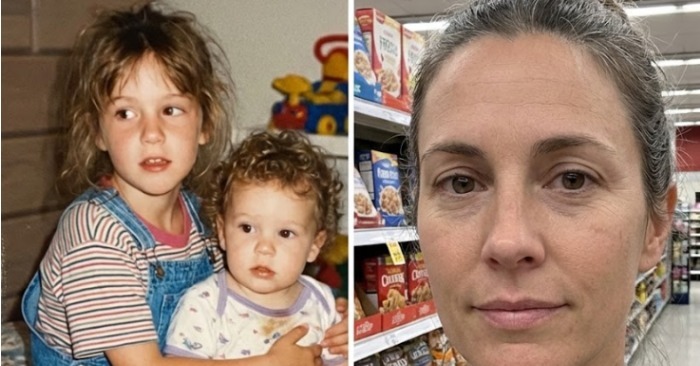
I grew up in an orphanage, and when I was eight, I was torn away from my little sister, and the next three decades were spent wondering if she was still alive.
Until a simple business trip and a visit to a shopping center turned into something I still can’t fully explain.
My name is Elena. When I was eight, I promised my sister I would find her.
Then I spent 32 years unsuccessfully trying to do that.
Mija and I grew up in the orphanage.
We didn’t know our parents. No names, no photos, no stories of “one day they’ll return.” Just two beds in a crowded room and a few lines in a file.
We were inseparable.
She followed me everywhere, gripping my hand in the hallway, and when she woke up and didn’t see me next to her, she would cry.
I LEARNED TO BRAID HER HAIR WITH MY FINGERS, SINCE WE DIDN’T HAVE A COMB.
I learned to braid her hair with my fingers, since we didn’t have a comb. I learned to sneak extra pastries so we wouldn’t get caught. I learned that if I smiled and answered questions correctly, the adults would treat us more kindly.
We didn’t have big dreams.
We just wanted to leave that place together.
One day, a couple visited us.
They walked with the director, nodded, and smiled. The kind of people who looked like they had just stepped out of the brochure “Adopt, Don’t Leave.”
They watched the playing children.
They watched me in the corner, reading a book to Mija.
A few days later, the director called me into her office.
“ELENA,” SHE SAID WITH A SMILE A LITTLE TOO WIDE, “THE FAMILY WANTS TO ADOPT YOU.
“Elena,” she said with a smile a little too wide, “the family wants to adopt you. These are wonderful news.”
“And Mija?” I asked.
She sighed as though she had rehearsed this answer many times.
“They’re not ready for two children,” she said. “She’s still small. Other families will come to pick her up. One day, you will meet.”
“I’m not going anywhere,” I said. “Not without her.”
Her smile faded.
“You don’t have the right to refuse,” she said softly. “You need to be brave.”
“Brave” meant “do what you’re told.”
THE DAY THEY CAME TO PICK ME UP, MIJA GRIPPED MY WAIST AND STARTED SCREAMING.
The day they came to pick me up, Mija gripped my waist and started screaming.
“Don’t go, Lena!” she sobbed. “Please, don’t go. I’ll be good, I promise.”
I held her so tightly that a staff member had to forcibly tear us apart.
“I will find you,” I kept repeating non-stop. “I’ll come back. I promise, Mija. I promise.”
She was still shouting my name when they put me in the car.
That sound haunted me for decades.
My new family lived in another state.
They weren’t bad people. They gave me food, clothes, a bed in a room without other children. They called me “happy.”
BUT THEY COULDN’T STAND TALKING ABOUT MY PAST.
But they couldn’t stand talking about my past.
“You don’t need to think about the orphanage anymore,” my stepmother would say. “Now we are your family. Focus on that.”
I improved my English, learned to fit in at school, learned that mentioning my sister quickly made conversations awkward.
So I stopped talking about her out loud.
But in my mind, she never stopped existing.
When I turned 18, I went back to the orphanage.
The staff had changed. There were new children. The paint on the walls was still peeling.
I told them my old name, my new name, and my sister’s name.
THE WOMAN FROM THE OFFICE WENT TO THE ARCHIVE AND CAME BACK WITH A SMALL FILE.
The woman from the office went to the archive and came back with a small file.
“Your sister was adopted soon after you,” she said. “Her name was changed, and the file was sealed. I can’t tell you anything more.”
“Is she okay? Is she alive? Please, tell me at least that?”
She shook her head.
“I’m sorry,” she said. “We don’t have the right.”
I tried again after a few years. Same answer.
The file was sealed. The name was changed. No information.
It felt like someone had erased her and written a new life on top.
MEANWHILE, MY LIFE WENT ON JUST LIKE EVERYONE ELSE’S.
Meanwhile, my life went on just like everyone else’s.
I graduated, worked, married too young, divorced, moved, got a promotion, learned to drink good coffee instead of instant.
From the outside, I seemed like a functional adult woman living a normal, somewhat boring life.
Inside, I never stopped thinking about my sister.
When I saw arguing sisters in the store, I remembered her.
When I saw a little girl with braids holding her older sister’s hand, I felt that emptiness.
Some years, I tried to find her through online searches and agencies. Other years, I just couldn’t bear the thought of hitting another wall.
She became a ghost I couldn’t fully mourn.
LET’S MOVE TO LAST YEAR.
Let’s move to last year.
The company sent me on a three-day business trip to another city. It wasn’t even a fun trip. Just a place with office complexes, a cheap hotel, and a decent little café.
That’s where I saw her.
On the first evening, I went to the nearby shopping center to buy food.
I was tired, thinking about emails, and mentally cursing the person who scheduled a meeting at 7 AM.
I turned into the cookie aisle.
There stood a girl about nine or ten, looking very seriously at two different packs of cookies, as if it were a matter of life or death.
When she reached out, the sleeve of her jacket slipped down.
THEN I SAW IT.
Then I saw it.
I froze as if I had hit a wall.
On her wrist was a small braided red and blue bracelet.
It wasn’t just similar.
The same colors. The same careless finish. The same ugly knot.
When I was eight, the orphanage received a box of craft supplies. I stole red and blue thread from the pile and spent hours trying to make two “friendship bracelets” I had seen on older girls’ wrists.
They were crooked and tied too tightly.
I tied one on my own wrist.
The other, I tied on Mija’s.
“So you won’t forget me,” I told her. “Even if we have different families.”
It was still on her wrist the day I left.
I stared at the bracelet on the child’s wrist. My fingers even tingled, as if my body remembered how it was made.
I approached closer.
“Hi,” I said gently. “Your bracelet is really cool.”
She looked at me without fear, only with curiosity.
“Thank you,” she answered, showing it to me. “My mom gave it to me.”
DID SHE MAKE IT HERSELF? — I ASKED, TRYING NOT TO LOOK LIKE A MADWOMAN.
“Did she make it herself?” — I asked, trying not to look like a madwoman.
The girl shook her head.
“She said someone special made it for her when she was little,” she said. “And now it’s mine. I have to keep it safe, or mom will cry.”
I chuckled a little, although there was a lump in my throat.
“Is your mom here?”
“Yes,” she answered, pointing to the aisle. “She’s over there.”
I looked.
A woman was walking toward us, with a cereal box in her hands.
Dark hair. No bright makeup. Jeans. Sneakers. Between 30 and 35 years old.
Something jolted in my chest.
Her eyes. Her walk. The way she furrowed her brows, trying to read the labels.
The girl ran to her.
“Mom, can we get these chocolate ones?” she asked.
The woman smiled at her, then looked at me.
She glanced at her daughter’s wrist and smiled.
She had the same eyes as four-year-old Mija, only on an adult woman’s face.
I stepped closer before I had time to be scared.
“Good afternoon,” I said. “Sorry, I was just admiring your daughter’s bracelet.”
“She loves that bracelet,” she said. “She never takes it off.”
“Because you said it’s important,” the girl reminded her.
“Did someone give it to you?”
“You could say so,” the woman answered.
I swallowed hard.
“Did someone give it to you?” — I asked. — “When you were a child?”
Her expression shifted slightly.
“Yes,” she answered slowly. “A long time ago.”
“At the orphanage?” — it slipped out.
Her face turned pale.
Her gaze drilled into mine.
For a moment, we just stared at each other.
“Where do you know this from?” — she asked.
“I grew up in a similar place,” — I answered. “And I made two of those bracelets. One for myself. One for my little sister.”
“What was your sister’s name?” — I asked with a trembling voice.
She hesitated, then said: “Her name was Elena.”
My knees almost gave way.
“That’s my name,” — I managed to say.
The girl’s mouth dropped open.
“Mom,” — she whispered. “Just like your sister.”
The woman looked at me as if she saw a ghost she had been waiting for and feared at the same time.
“Elena?” — she asked in a barely audible voice.
“Yes,” — I answered. “It’s me. I think.”
We just stood there, in the cookie aisle, like fools.
Cartons passed by. Someone laughed near the milk section. Life went on.
The little girl, whose name I later found out was Lili, looked at us as if she had accidentally walked into a movie.
“Are you my mom’s sister?” — she asked me.
“I think so,” — I answered.
The woman grabbed the shopping cart handle as if she needed something to hold onto.
“Can we… talk?” — she asked. — “Not… here?”
“Of course,” — I answered.
We paid for our items and went to a sad little café by the store.
We sat at a sticky table. Lili drank hot chocolate. We got coffee we didn’t drink.
Up close, all my doubts vanished.
Her nose. Her hands. Her nervous laugh. It really was Mija, just older.
“What happened after you left?” — she asked. — “They told me you found a good family and… that was it.”
“I was adopted,” — I answered. — “They took me to another state. They didn’t want to talk about the orphanage or you. When I turned eighteen, I went back there. They told me you were adopted, changed your name, and your file was sealed. I tried again later. Same thing. I thought maybe you didn’t want to be found.”
Her eyes filled with tears.
“They adopted me a few months after you,” — she said. — “They changed my last name. We moved a few times. Every time I asked about my sister, they would say, ‘That part of your life is over.’ I tried to find you when I grew up, but I didn’t know your new name or where you went. I thought you had forgotten me.”
“Never,” — I answered. — “I thought you were the one who left me.”
We both laughed — that sad laugh, when everything hurts but it’s also right.
“And the bracelet?” — I asked.
She glanced at Lili’s wrist.
“I kept it in a box for many years,” — she answered. — “It was the only thing I had from my past. I couldn’t wear it anymore, but I couldn’t throw it away. When Lili turned eight, I gave it to her. I told her it was from someone very important. I didn’t know if I would ever see you, but I didn’t want it gathering dust in a drawer.”
Lili proudly extended her hand.
“I take good care of it,” — she said. — “See? It’s still in good condition.”
“You did a great job,” — I said, with a breaking voice.
We talked until the café started closing for the night.
We talked about work. Children. Partners and exes. About little silly memories that perfectly matched.
About the cracked blue mug everyone fought over.
About the hideout under the stairs.
About the volunteer who always smelled like oranges.
Before we parted, Mija looked at me and said: “You kept your promise.”
“What promise?” — I asked.
“You said you would find me,” — she answered. — “And you did.”
I hugged her tightly.
It was strange: two strangers, bound by blood and stolen childhoods. But it was also the most right feeling I’ve had since I was eight.
We started slowly.
We exchanged numbers and addresses.
We didn’t pretend those 32 years never happened.
Messages. Calls. Photos. Visits when we had time and money for flights.
We’re still finding our way. We both created lives without each other, and now we’re trying to bring them together without tearing anything apart.
Having searched for her for so many years, I never imagined I would find her this way.
But today, when I remember that day in the orphanage, the gravel under my feet, Mija shouting my name, another image overlays that memory:
Two women in a store café, laughing and crying over bad coffee, while a little girl swings her legs, guarding a crooked red and blue bracelet like the greatest treasure.