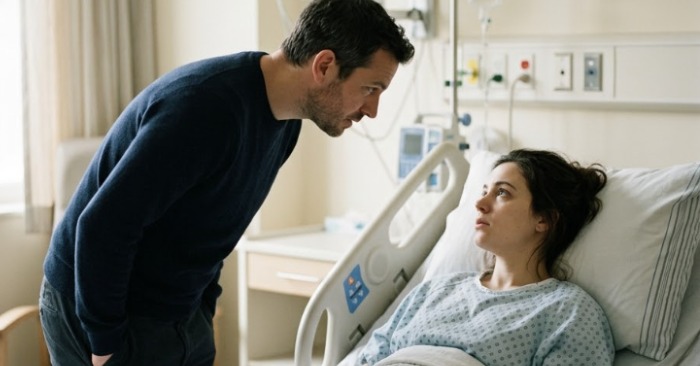
Lucia opened her eyes as dusk slowly settled over the city outside the hospital room window. She felt a heaviness in her head and that familiar weakness that hadn’t left her since the previous day. The second day in the hospital wasn’t easy—her strength was returning painfully slowly, and every movement required effort. She lay still, staring at the white ceiling, trying not to think about how long this state would last.
The attack had come suddenly. Late in the evening, after finishing dinner preparations, Lucia felt a sharp pain in her abdomen. At first, she assumed it was something she had eaten, but within an hour the pain became unbearable. Marco called an ambulance, the doctors quickly understood what was happening, and she was taken to the hospital. The diagnosis was serious—acute pancreatitis with complications. She needed observation, IV drips, and absolute rest.
She hadn’t expected to see Marco. When they took her away, he stayed home, saying he would come the next morning. But the morning passed, then the afternoon, and only now, toward the evening of the second day, the door to her room opened. Lucia turned her head and saw her husband. There was no concern or worry on his face—just the ordinary expression of someone who had come to take care of business.
“You came,” she said quietly, trying to lift herself onto her elbow. The movement caused pain, and she sank back onto the pillow.
Marco nodded and looked around the room—three beds, small tables, a window facing a neighboring building. His gaze passed over the IV and the equipment, but his face remained indifferent. He stepped closer but didn’t sit beside her. Instead, he stopped at the foot of the bed, leaning against its frame.
“How do you feel?” he asked without much interest, as if saying it out of obligation.
“Better than yesterday,” Lucia replied. “The doctor says the worst is over, but I still have to stay here. At least five days, maybe a week.”
Marco frowned. Lucia noticed his shoulders tense and his eyes narrow. She knew that look all too well—it always appeared when something didn’t go his way.
“A WEEK?” HE REPEATED. “WHY SO LONG?”
Lucia sighed. She didn’t have the strength to explain details, didn’t want to justify herself. But habit took over.
“It was pancreatitis, Marco. It’s serious. It takes time to recover.”
Marco sat down but still kept his distance. He took out his phone, glanced at the screen, and slipped it back into his pocket. Lucia saw he was choosing his words. She waited for him to ask about the treatment, about the doctors, whether she needed anything from home. But Marco began talking about something entirely different.
“The house is a mess,” he started, looking not at her but toward the window. “Yesterday I tried to cook something, but it was a disaster. Burned the pan, ruined a pot too. I don’t even know where you keep things in the kitchen.”
Lucia stayed silent. She understood where this was going but didn’t want to believe he would actually say it.
“The laundry isn’t done,” Marco continued. “I’m out of shirts, had to wear an old one. The fridge is almost empty. I bought ready-made food, but it’s not the same.”
Lucia closed her eyes. She wanted to shout that she hadn’t ended up here by choice, that an ambulance had taken her away in unbearable pain, that she had barely been conscious. Instead, she asked quietly:
“AND WHAT DO YOU SUGGEST?”
Marco looked at her without a trace of understanding. He spoke as if it were an ordinary, everyday matter.
“You’ve rested enough,” he said firmly. “There’s a lot of work at home, and you’re just lying here.”
Lucia froze. The words sounded so casual that for a moment she thought she had misheard. Slowly, she opened her eyes and looked at him, trying to understand if it was a joke. But his face was completely serious.
“What did you say?” she asked quietly.
“That it’s time to come home,” he repeated with slight impatience. “You’ve been here two days already, that’s enough. Doctors always exaggerate. They keep people in the hospital longer than necessary. And I’ve got a pile of responsibilities at home. I don’t have time to cook and clean.”
Lucia slowly lifted herself onto her elbow, ignoring the weakness. The IV tube tightened slightly; she adjusted it carefully. Her gaze became sharp, penetrating—as if for the first time in years she was truly looking at the man she had spent so much time with.
“Do you really think I’m resting here?” she asked, firmness entering her voice.
MARCO SHRUGGED.
“What else are you doing? You’re lying in bed, they bring you food, they take care of you. No rush, no responsibilities. I’d rest like that myself.”
Lucia felt her face burn. She clenched her hands to keep from crying, from raising her voice. Inside, everything was boiling—outrage, pain, the realization that the man standing beside her wasn’t even trying to understand what she was going through.
“Marco,” she said slowly. “I’m not resting. I’m being treated. I had a serious attack. The pain was so intense I couldn’t breathe. They brought me here by ambulance, I’m on medication, IV drips. This is not a vacation.”
Marco waved his hand.
“You’re exaggerating. It’s always like this—you turn every little thing into a tragedy. Your stomach hurt, so what? You could’ve taken a pill at home and it would’ve passed.”
Lucia fell silent. She understood that the conversation was pointless. Marco wasn’t listening. He didn’t want to listen. To him, her illness was just an inconvenience, something that disrupted his routine. He didn’t care how she felt, how much she suffered. Only one thing mattered—who would take care of the house.
“I’m not going home early,” she said firmly. “The doctor will decide that, not you.”
MARCO CLENCHED HIS LIPS. HE STOOD UP, TOOK A FEW STEPS, AND STOPPED BY THE WINDOW. THE TENSION IN HIS SILHOUETTE WAS CLEAR. HE HAD OBVIOUSLY EXPECTED A DIFFERENT REACTION—SUBMISSION, EXPLANATIONS. BUT LUCIA HAD NO STRENGTH LEFT FOR THAT.
“You know what I think?” he said, turning around. “That you just don’t want to come back. You’re comfortable here, hiding behind the doctors. And I’m supposed to split myself between work and home?”
“You can hire someone,” she replied calmly. “There are cleaning services, food deliveries. Or you could ask your mother. She lives nearby.”
Marco’s face hardened.
“My mother? So she can go around telling everyone what kind of wife I have? That she’s lying in the hospital while I do everything myself? No, thanks.”
Lucia closed her eyes. This conversation was going nowhere.
“Listen,” Marco said more gently. “I don’t want to hurt you. I’m just tired. Work, the house—it’s all on me. Do you understand how hard it is for me without you?”
He spoke calmly, almost kindly, and if Lucia didn’t know him so well, she might have believed him. But she heard something else beneath it—impatience and a desire to restore the old order as quickly as possible.
LUCIA LOOKED AT HIM CAREFULLY. THERE WAS NO FEAR OR COMPASSION IN HIS EYES. ONLY COLD CALCULATION.
“I understand it’s not easy for you,” he continued. “But try to understand me. I have to go to work tomorrow, and the house is chaos. You’ve already been here two days, you must be feeling better. It’s time to come back.”
Lucia felt something inside her shift. It wasn’t sudden anger. It was a calm, cold realization.
Suddenly, she saw not only the man in front of her but their entire life together.
The early years. Marco coming home with flowers for no reason. Evenings in their small kitchen, laughter, cooking together. Back then, he was different—warmer, attentive.
Then something changed.
First, he stopped helping. Then he stopped noticing how much she did. Eventually, he took it all for granted.
And suddenly Lucia understood something else.
ALL THOSE YEARS, MARCO HAD NEVER ASKED HER ONE QUESTION.
He had never asked if she was tired.
“Marco,” she said quietly.
“What?”
“Tell me honestly… if I died right now… would you still say the house is a mess?”
Marco fell silent.
“What kind of nonsense is that?” he muttered.
“Answer me.”
“OF COURSE NOT.”
Lucia nodded.
“Exactly.”
Silence fell.
“For you, there are only two options,” she said calmly. “Either I work at home, or I ‘rest.’ Nothing in between exists.”
“There you go again…”
“I’m not starting anything. I’m finishing it.”
“What are you finishing?”
“This conversation.”
“What does that mean?”
“It means I’m staying in the hospital as long as necessary. And you go home and handle things yourself.”
Marco straightened abruptly.
“Are you serious?”
“Yes.”
“You’re trying to prove a point?”
Lucia shook her head.
“NO. I JUST DON’T WANT TO BE CONVENIENT FOR EVERYONE ANYMORE.”
Marco clenched his jaw.
“If you think you’ll lie here for weeks while I handle everything, you’re wrong.”
“I’m not thinking that.”
“Then what are you thinking?”
Lucia looked at the IV.
“I think that for fifteen years I did everything to make our house a real home,” she said quietly. “And to you, it was just a service.”
Marco looked away.
AT THAT MOMENT, THE DOOR OPENED AND A NURSE ENTERED THE ROOM. SHE CHECKED THE IV AND INFORMED THEM THAT VISITING HOURS WERE ENDING SOON.
Marco sighed as if it were just another inconvenience. He put on his jacket and headed for the door.
“Do whatever you want,” he threw over his shoulder without turning around. “But don’t say I didn’t warn you.”
Lucia said nothing. She simply watched the door close.
When silence filled the room again, she slowly sank back onto the pillow. The weakness was still in her body, but it no longer weighed on her as before.
Something new had appeared inside her.
A sense of freedom.
She stared at the ceiling and, for the first time in many years, wasn’t afraid to be alone.
THE NEXT MORNING, THE DOCTOR CAME. HE CHECKED THE RESULTS AND NODDED.
“There’s improvement,” he said. “But discharge no earlier than a week. The pancreas doesn’t like to be rushed.”
“I understand,” Lucia replied.
The doctor looked at her carefully.
“Is someone waiting for you at home?”
Lucia thought for a moment.
“Yes,” she said. “But that’s no longer the most important thing.”
The doctor smiled slightly and left.
LUCIA PICKED UP HER PHONE. FOR A MOMENT, SHE LOOKED AT THE SCREEN. MARCO’S NAME WAS FIRST ON THE LIST.
She didn’t call.
She opened another message.
From a real estate agent.
Slowly, she typed:
“Good morning. I would like to discuss selling the apartment. When can we meet?”
She sent the message.
She put the phone down and closed her eyes.
AHEAD OF HER WAS A WEEK OF TREATMENT AND REST.
And then—a completely new life.